
Ask David: What Is Stalling Climate Finance?
Climate finance reached $2T last year, that needs to triple by 2035. Here’s how policymakers and financial institutions can help close that gap.

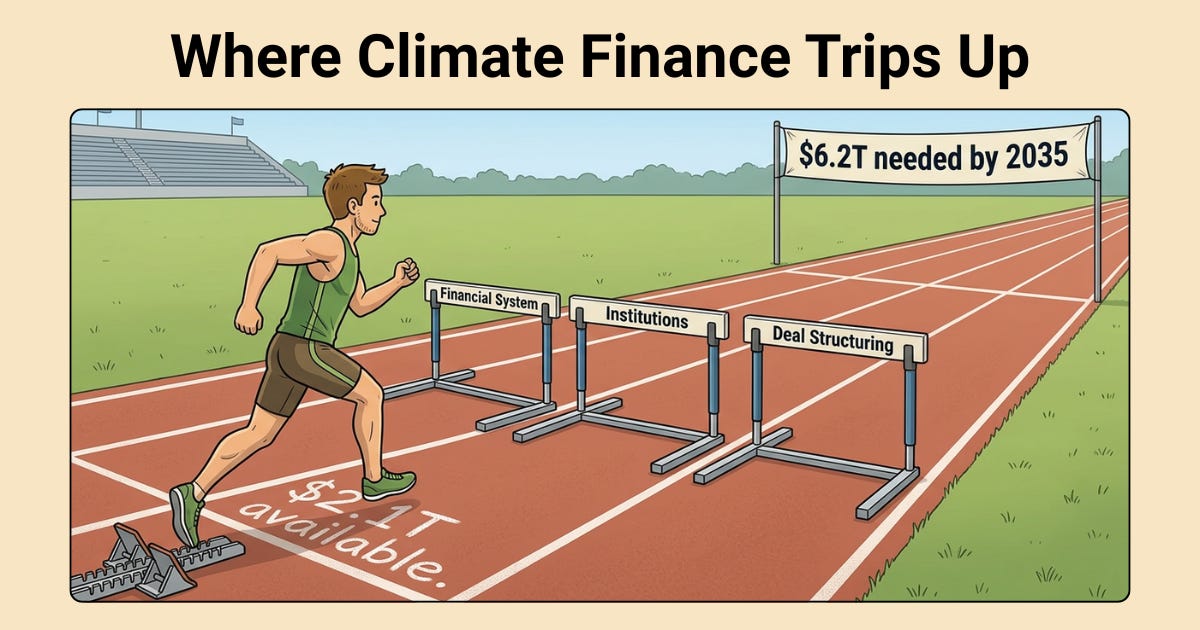
Climate finance has reached record levels. Yet the capital being mobilized remains far below what is required, and it often fails to reach the locations and projects where it could make the greatest difference.
The Climate Policy Initiative (CPI) estimates that global climate finance surpassed $2 trillion in 2024/2025 and may have reached $2.1 trillion in 2025. That is significant progress. However, sustained double-digit growth is required to meet our global climate goals. CPI estimates that annual flows must reach at least $6.2 trillion by 2035.
The shortfall reflects a chain of interconnected obstacles. Some sit within public policy and the wider financial system. Others arise inside financial institutions. A third group emerges when an individual transaction is being structured.
Looking at these three levels helps explain why growing investor interest has not yet translated into climate finance at the required scale.
This is Ask David, an ongoing series where David answers the questions sustainability teams are navigating today and offers actionable advice on demonstrating financial value, strengthening business strategy, managing risk, and driving real organizational impact.
If you want to submit a question to be answered in a future edition, let us know in the comments section.
1. How large is the climate finance gap, and where is it most acute?
The headline numbers are substantial, but they conceal a very uneven picture.
Of all climate finance, approximately $1.9 trillion went toward mitigation, with much of this concentrated in energy. Technologies such as solar, wind, electric vehicles, and batteries have benefited from falling costs, established business models, and stronger policy support. Capital has followed as these opportunities have become increasingly competitive and familiar.
Other areas remain severely underfunded. These include adaptation, nature, agriculture, industrial transition, and ocean conservation. Many projects in these areas create considerable economic and social value, but their revenue models are less developed or their benefits are more difficult for individual investors to capture.
The adaptation gap is particularly stark. According to UNEP’s Adaptation Gap Report 2025, developing countries may require between $310 billion and $365 billion annually for adaptation by 2035. International public adaptation finance flows were just $26 billion in 2023. UNEP estimates that adaptation needs are 12 to 14 times current flows.
Aggregate figures can mask where capital is flowing and what it is financing. Money tends to move toward assets, technologies, and markets that investors already understand. Harder-to-finance areas can be crowded out, even when the wider economic case for investment is strong.
In my work with financial institutions and development finance organizations, I often see considerable appetite for mature renewable-energy transactions. The pipeline becomes much thinner when we move into adaptation, emerging technologies, smaller businesses, or more difficult markets. That is where the financing challenge becomes most acute.
