
Ask David: How should sustainability teams be using AI?
Sustainability teams have broad mandates and limited resources. Here’s how responsible use of AI can help close that gap.

AI has moved remarkably quickly from experimentation to everyday business use. Eurostat found that 20% of EU enterprises were using AI technologies in 2025, up from 13.5% just one year earlier.
Sustainability is no exception. Almost every sustainability team I speak with is now using AI somewhere. But there is a huge difference between experimenting with a chatbot and fundamentally changing how a function operates.
There is enormous potential here. Sustainability teams tend to have broad mandates, significant data and reporting requirements, and relatively limited resources. AI can change that equation. But leaders are also under pressure to deploy it quickly, reduce costs and automate work, sometimes before organizations have really worked out where it adds value.
So where are sustainability teams using AI today, and how should they approach what comes next?
This is Ask David, an ongoing series where David answers the questions sustainability teams are navigating today and offers actionable advice on demonstrating financial value, strengthening business strategy, managing risk, and driving real organizational impact.
If you want to submit a question to be answered in a future edition, let us know in the comments section.
1. How are sustainability teams actually using AI today?
Almost every sustainability team we speak to is now using AI in some form. But the sophistication of those applications varies significantly.
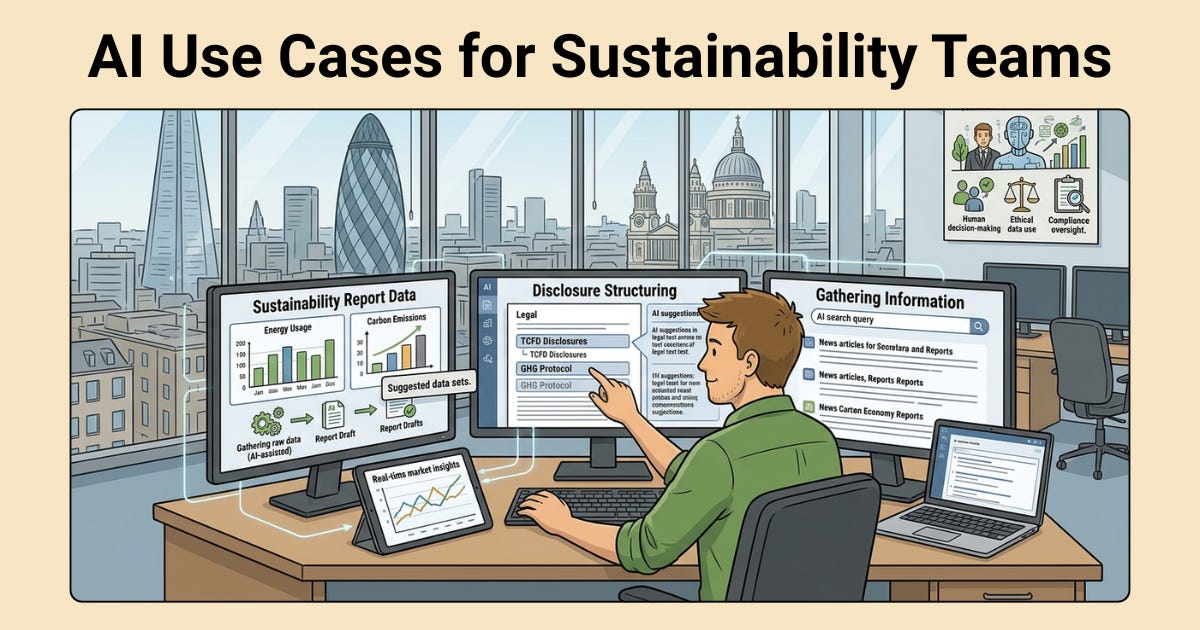
Reporting is probably the most common use case today. Teams are looking at how AI can reduce the considerable amount of time spent gathering information, reviewing requirements, structuring disclosures and, increasingly, helping put reports themselves together.
That makes sense. Sustainability reporting involves large volumes of structured and unstructured information, often spread across different systems and teams. Much of the work involves gathering, reconciling, checking and organizing information before the higher-value judgment even begins.
But reporting is really just the tip of the iceberg.
We are beginning to see more interesting applications emerge around risk data and analysis, regulatory monitoring, research and other sustainability processes. At the same time, organizations are developing policies and controls around how AI should be used, particularly given concerns around confidentiality, accuracy and reliability.
Reporting may be where adoption has started, but I think we are at the beginning of a much larger shift in how sustainability teams operate.
